
01How to use this guide
Leihaao gives your plant a pH-balanced base with measured N, P and K, so feed extra only when the leaf colour chart says so. Look at your plant once a week, match a leaf to the chart, and follow the dose for that shade.
Three rules before you feed
- Check the soil first. Yellow leaves in wet, soggy soil usually mean overwatering, not hunger. Let the pot dry a little before feeding.
- Always feed moist soil. Water lightly, then pour the fertiliser solution, so the roots do not burn.
- Less is safer. If you are unsure between two shades, use the lower dose.
Measuring
- 1 tsp = one level kitchen teaspoon (about 5 ml of liquid or 4–6 g of powder). Level it off with a knife.
- All doses in this guide are per 1 litre of water. Dissolve fully and use the same day.
- Water at room temperature works best. Rainwater or water stored overnight is ideal.
How much solution to pour per pot
| Pot size | Examples | Solution per feed |
|---|---|---|
| Small (4–6 inch) | herbs, seedlings, succulents | 100 ml (half a cup) |
| Medium (8–10 inch) | chilli, brinjal, marigold, spinach | 250 ml (1 cup) |
| Large (12 inch and above, grow bags) | tomato, okra, gourds, small fruit plants | 500 ml (2 cups) |
The Leihaao bag itself works as a large grow bag once you cut, fold and plant.
02Leaf colour chart and NPK doses
Match your leaf to the chart below. Shades 1 to 3 need NPK, shades 4 and 5 need nothing, and shade 6 means you have overfed.
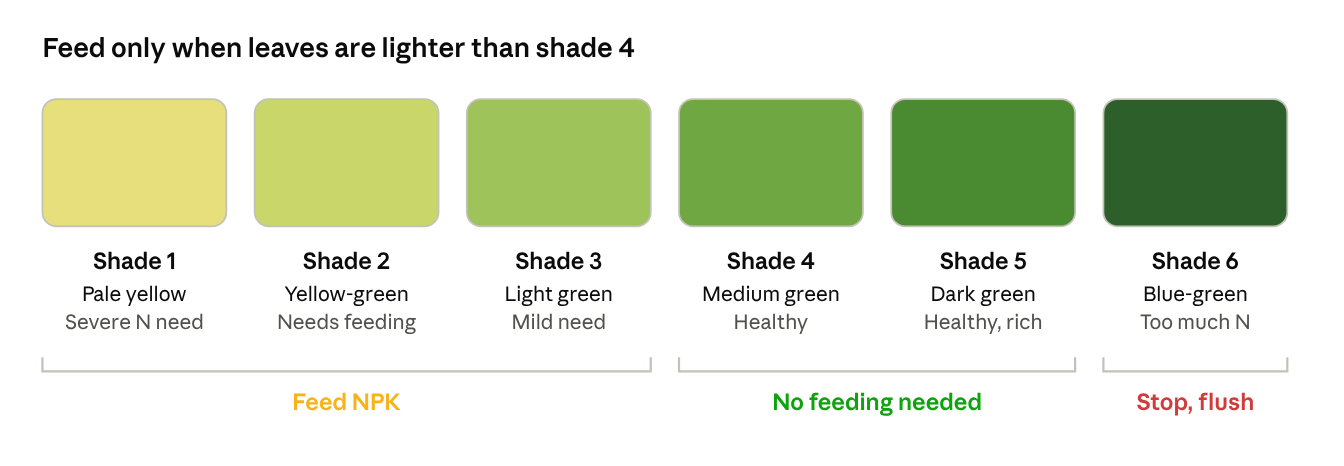
Leihaao leaf colour chart · 6 shades
How to read the chart correctly
- Pick the youngest fully opened leaf, usually the 3rd leaf from the top. Very new leaves are always lighter, and old bottom leaves are always darker.
- Read in daylight, but in shade, with your back to the sun. Direct sunlight makes every leaf look lighter.
- Hold the middle of the leaf flat against the chart. Do not compare the tip or the base.
- Check 5 leaves from different plants or branches. Use the shade most of them match.
- If a leaf falls between two shades, take the lighter shade's dose of the two, only if it is 3 or below.
- Some varieties are naturally light green (lettuce, some basil) or naturally dark (curry leaf, spinach). Note your plant's colour when it is healthy and compare against that.
What to feed for each shade
Doses use a water-soluble NPK 19:19:19 fertiliser, dissolved in 1 litre of water. Pour the amount for your pot size from the table in the section above.
| Shade | What the leaf tells you | NPK 19:19:19 per litre | How often | Next step |
|---|---|---|---|---|
| 1 Pale yellow | Plant is starving, growth has stopped | 1 tsp | Every 7 days | Re-check after 2 feeds. If still pale, see the next section |
| 2 Yellow-green | Nutrients are running low | ¾ tsp | Every 10 days | Re-check after 2 feeds |
| 3 Light green | Early sign of need | ½ tsp | Every 15 days | Stop once leaves reach shade 4 |
| 4 Medium green | Healthy, balanced | None | — | At flowering and fruiting only, ¼ tsp once a month |
| 5 Dark green | Healthy, well fed | None | — | Keep watching weekly |
| 6 Blue-green | Too much nitrogen. Soft growth, few flowers, attracts aphids | Stop all feeding | — | Flush the pot with plain water (twice the pot's volume) and wait 3–4 weeks |
For fruiting plants (tomato, chilli, brinjal) that are at shade 4 or 5 but flowering poorly, a high-potash feed such as 13:0:45 at ½ tsp per litre every 15 days supports flowers and fruit.
03How to identify symptoms
Where a symptom starts on the plant points to its cause. Nutrients that can move inside the plant (N, P, K, Mg) leave the old leaves first. Nutrients that cannot move (Ca, S, Fe, Mn, Zn, B) show up on the new leaves first.
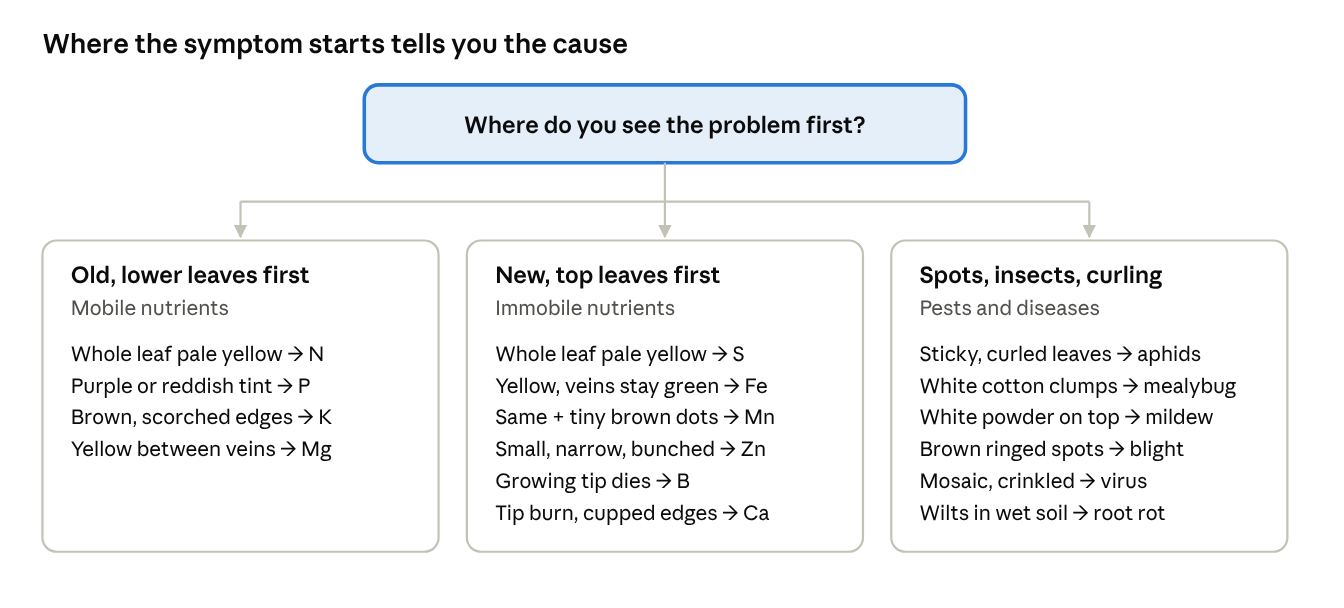
Symptom finder · 3 starting points
The 7-step plant check (5 minutes, once a week)
- Look at the whole plant from 1 metre away. Is it upright or drooping? Is growth even or is one side weak? Note whether the problem is on one plant or all of them. If all plants in the same spot show it, suspect water, sun or heat first.
- Push a finger 2 cm into the soil. Soggy soil with yellow leaves means overwatering. Dry, hard soil with limp leaves means underwatering. Fix watering before you feed.
- Find where the symptom starts. Old bottom leaves, new top leaves, or scattered spots. Use the symptom finder above.
- Read the pattern on the leaf.
- Uniform yellow over the whole leaf: nutrient shortage (N or S).
- Yellow between the veins, veins stay green: Mg on old leaves, Fe or Mn on new leaves.
- Brown or burnt edges: K shortage, salt build-up from overfeeding, or sun scorch.
- Spots with rings, fuzzy growth or powder: fungus.
- Irregular light and dark green patches with crinkling: virus.
- Turn the leaf over. Most insects hide on the underside and at stem joints. Use your phone camera's zoom as a magnifier.
- Do the white paper tap test. Hold a white sheet under a branch and tap it. Tiny moving dots are aphids, mites or thrips.
- Match a healthy-looking leaf to the leaf colour chart and note the shade, date and what you saw. Re-check the same plant in a week to see if it is getting better or worse.
Nutrient symptoms in detail
| Nutrient | Shows first on | What you see | Often mistaken for |
|---|---|---|---|
| Nitrogen (N) | Old leaves | Whole leaf turns pale green then yellow, slow and thin growth. Leaf colour chart shade 1–3 | Overwatering, natural ageing of 1–2 bottom leaves |
| Phosphorus (P) | Old leaves | Dull dark green with a purple or reddish tint on the underside and stems. Few flowers, weak roots | Cold nights, which also cause purpling |
| Potassium (K) | Old leaves | Yellow then brown, crispy leaf edges and tips. Fruits small or ripen unevenly | Salt burn from overfeeding, sun scorch |
| Magnesium (Mg) | Old leaves | Yellow between the veins while veins stay green, like a Christmas-tree pattern. Sometimes reddish | Potassium shortage (Mg starts in the middle of the leaf, K at the edges) |
| Calcium (Ca) | New leaves, fruit | New leaves curled or hooked with burnt tips. Black, sunken bottom on tomato and chilli fruit (blossom-end rot) | Uneven watering, which blocks calcium uptake |
| Sulphur (S) | New leaves | Whole young leaf evenly pale yellow, veins included | Nitrogen shortage (N starts on old leaves) |
| Iron (Fe) | Newest leaves | Bright yellow to almost white between veins, veins stay sharp green | High pH or waterlogged roots |
| Manganese (Mn) | New and middle leaves | Pale between veins with tiny brown dead spots, a checkered look | Iron shortage (Mn has spots, Fe does not) |
| Zinc (Zn) | New leaves | Small, narrow leaves bunched at the tip (rosette), mottled yellow | Virus or mite damage |
| Boron (B) | Growing tip | Tip dies, new leaves thick and brittle, flowers drop, hollow or cracked stems | Calcium shortage |
| Copper (Cu) | New leaves | Rare. Young leaves limp, twisted, dark blue-green tips | Underwatering |
If two or more symptoms show at once, the cause is usually the roots: overwatering, a root-bound pot or a pH problem. Correct that before adding any single nutrient.